
Every business has a pipeline.
The problem is that many businesses are using the wrong one.
A recruiting agency doesn't sell the same way as a marketing agency. A contractor doesn't follow the same process as a SaaS company. Yet many CRMs start everyone with the exact same stages and expect them to fit every business.
At first, it works well enough.
A few months later, deals start piling up. Salespeople aren't sure when to move opportunities forward. Managers lose confidence in forecasts. Pipeline reviews become conversations about cleaning up the CRM instead of discussing how to close more business.
The best pipeline isn't the one with the most stages.
It's the one that reflects how your business actually works.
Your pipeline should tell the story of how you win customers
Forget your CRM for a minute.
Think about the last customer you closed.
What actually happened?
Maybe they filled out a contact form. You scheduled a discovery call, prepared a proposal, answered a few questions, negotiated pricing, and signed the agreement.
That's your pipeline.
Each stage should represent a meaningful milestone in that journey.
If you can't clearly explain why a deal belongs in a stage, the stage probably doesn't belong in your pipeline.
Stop copying someone else's workflow
One of the biggest mistakes small businesses make is copying a pipeline they found online.
The classic sales pipeline usually looks something like this:
- Lead
- Qualified
- Proposal
- Negotiation
- Won
There's nothing wrong with those stages.
They're just not right for everyone.
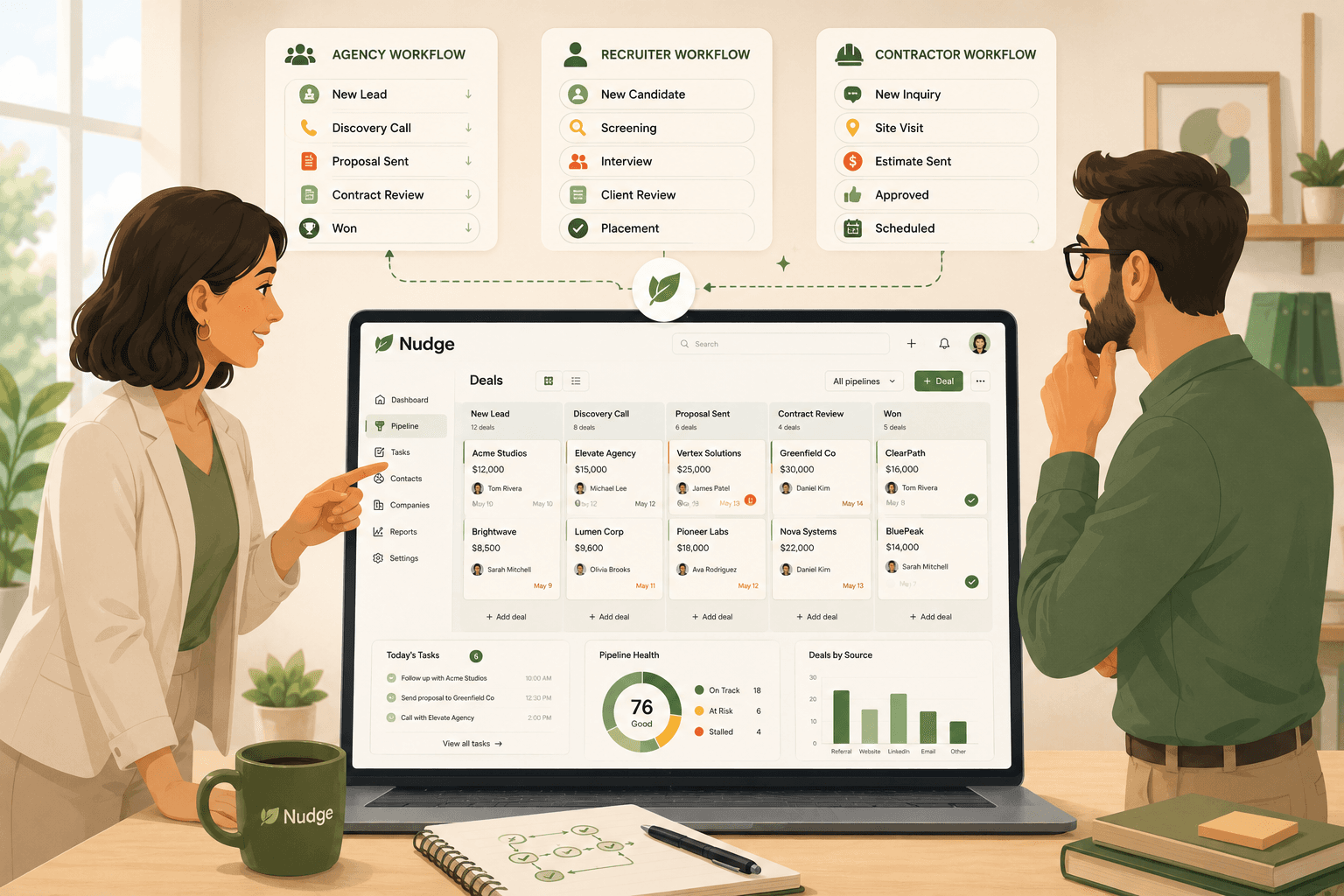
A recruiter may need stages like Screening, Interview, and Placement.
A contractor might move from Site Visit to Estimate Sent before a project is approved.
An agency could spend weeks refining a proposal before discussing contracts.
Different businesses have different buying journeys.
Your CRM should adapt to yours.
Keep your pipeline simple
It's tempting to create a stage for every little task.
Discovery Call.
Demo Complete.
Proposal Reviewed.
Proposal Updated.
Second Follow-up.
Soon your pipeline has twelve columns, and nobody knows where anything belongs.
Instead, let your stages represent customer decisions.
The work that moves a deal forward happens inside each stage.
The stage itself should represent meaningful progress.
A simple pipeline is easier to understand, easier to manage, and much easier to trust.
Every deal should answer three questions
Open any deal in your CRM.
Can you answer these questions in a few seconds?
- Who owns this opportunity?
- What's the next step?
- When is that happening?
If not, your pipeline isn't giving your team enough direction.
Deals rarely disappear because someone intentionally ignores them.
They usually fade away because the next action was never clear.
That's why visibility matters just as much as organization.
Your pipeline should evolve as your business grows
The way your business sells today probably isn't the way it sold a year ago.
Maybe you've added new services.
Maybe you've shortened your sales cycle.
Maybe you've learned that certain stages don't add much value anymore.
That's a good thing.
Your pipeline shouldn't stay frozen while your business changes around it.
Review it every few months.
Remove stages that create confusion.
Rename stages that no longer fit.
Simplify wherever possible.
A pipeline should become easier to use over time, not more complicated.
Different businesses need different workflows
A flexible CRM makes it easy to build a pipeline around your own process instead of forcing you into someone else's.
For example, an agency might use:
- New Lead
- Discovery Call
- Proposal Sent
- Contract Review
- Won
A recruiter could build a workflow like:
- New Candidate
- Screening
- Interview
- Client Review
- Placement
A contractor might track opportunities through:
- New Inquiry
- Site Visit
- Estimate Sent
- Approved
- Scheduled
The stages are different.
The goal is the same.
Give every opportunity a clear path from first conversation to completed work.
How Nudge helps you build the right pipeline
Nudge was built for businesses that don't fit inside a generic sales process.
You can create customizable pipelines that reflect the way your team actually works, whether you're running an agency, recruiting candidates, managing projects, or closing sales.
Custom fields let you capture the information that matters to your business, while every deal still requires an owner, a next step, and a due date.
That means your pipeline stays flexible without sacrificing accountability.
Instead of adapting your business to your CRM, your CRM adapts to your business.
Final Thoughts
There's no perfect pipeline template.
The best pipeline is the one your team actually wants to use.
When every stage reflects a real milestone, every deal has a clear owner, and every opportunity has a defined next step, your pipeline becomes more than a reporting tool.
It becomes the place your team goes every day to know exactly what needs to happen next.
That's how pipelines stay healthy.
And that's how more deals keep moving forward.