
Founder-led sales starts with an advantage: you know the product, the customer, and the problem better than anyone else.
Early on, that can make a formal sales system feel unnecessary. You know which prospects matter. You remember the conversations. The important follow-ups are still manageable.
Then the pipeline grows.
A few active conversations become twenty. Partnerships get mixed in with sales. Someone asks you to follow up next month. A promising prospect disappears under a week of product work. Eventually, remembering what happens next becomes part of the job.
At that point, choosing a CRM is not really about finding somewhere to store contacts. You already have places to store information.
The better question is: which CRM helps a founder keep selling without creating another system to manage?
Here is what to look for.
What does a founder actually need from a CRM?
Most founders do not need every feature available in a traditional sales platform.
They need enough structure to answer a handful of important questions quickly:
- Who are we talking to?
- Which opportunities are active?
- Where does each deal stand?
- What needs to happen next?
- Who owns that next step?
- When does it need to happen?
If answering those questions requires digging through email, Slack, notes, spreadsheets, and a CRM, the system is not doing enough of the work.
A useful founder CRM should reduce that uncertainty, not add another layer of administration.
1. A clear next step for every active deal
A pipeline full of opportunities can look healthy while very little is actually happening.
The stage tells you where a deal is. It does not necessarily tell you what moves it forward.
"Proposal sent" is a stage.
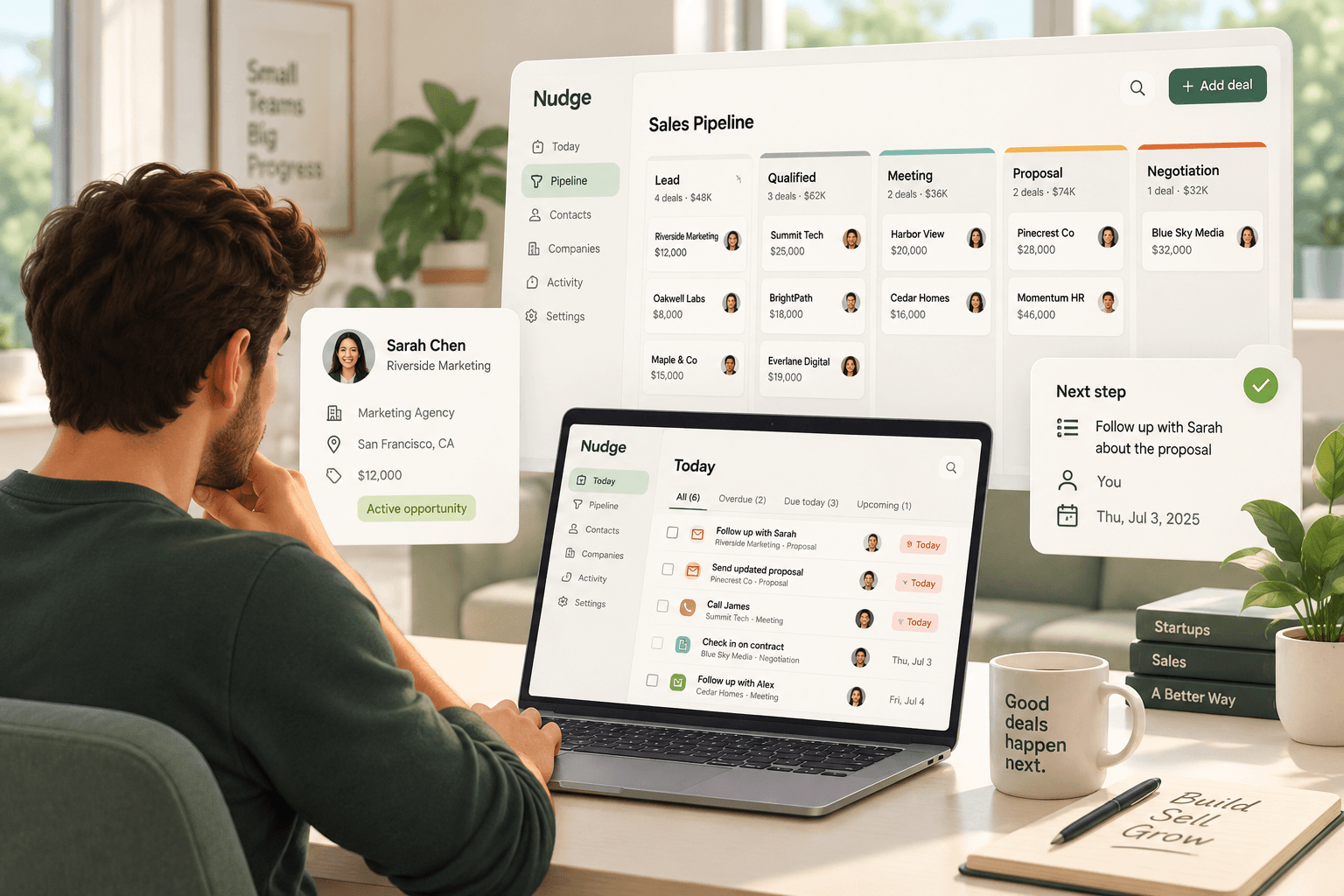
"Follow up with Sarah on Thursday about the proposal" is an action.
That distinction matters in founder-led sales because sales is competing with everything else on your calendar. A vague intention to follow up is easy to lose when product, hiring, fundraising, and customer issues take over.
Look for a CRM that keeps the next action visible and connects it directly to the opportunity.
Ideally, every active deal should answer three questions:
- Who owns it?
- What happens next?
- When does that happen?
That small amount of discipline can make the pipeline much more useful.
2. A daily view of what needs your attention
Founders rarely want to begin the morning by reviewing every opportunity in a pipeline.
You need to know what requires attention today.
That might include an overdue follow-up, a call scheduled for this afternoon, or a proposal that needs another touch before the week ends.
A CRM for founder-led sales should turn all of that into a practical work list rather than forcing you to inspect deals individually.
This is one of the ideas behind Nudge's Today list. It brings overdue, due-today, and upcoming work into one place so the CRM can function as a daily sales plan rather than just a database.
3. A pipeline you can understand at a glance
More pipeline stages do not automatically mean better sales management.
For an early-stage company, they can have the opposite effect.
Your pipeline should reflect meaningful changes in the sales process. A basic B2B pipeline might look something like:
Lead → Qualified → Meeting → Proposal → Negotiation → Won/Lost
Your actual stages may be different. The important part is that each one means something to you and anyone else who starts selling alongside you.
You should also be able to adapt the pipeline as the company evolves.
Nudge supports multiple pipelines, including shared and personal pipelines. That means a founder can keep different workflows separate instead of forcing everything into a single sales funnel.
For example, you might eventually have pipelines for:
- Sales
- Partnerships
- Fundraising
- Renewals
The structure should match the work, not force the work to match the software.
4. Enough customization without turning setup into a project
Every startup tracks slightly different information.
A SaaS founder might care about ARR, plan, number of seats, ICP fit, or decision date. A consultant might care about project type and budget. An agency may need service line, retainer size, or renewal date.
Your CRM needs room for those differences.
But there is a tradeoff.
Unlimited configuration is not automatically useful if it takes days to build the system before you can start selling.
Look for the ability to customize the information that matters without having to design an entire CRM architecture from scratch.
Nudge supports custom fields on businesses, contacts, and deals, including fields such as text, numbers, dates, selects, multi-selects, and URLs.
That gives founders room to model their sales process without making customization the job itself.
5. A practical way to bring your existing data with you
Almost nobody starts with an empty CRM.
Your contacts and opportunities are probably already somewhere.
They might be in a CSV. An Excel workbook. An export from another CRM. Or several sheets that made perfect sense six months ago and now require some archaeology.
Migration friction matters because a CRM that takes too much effort to set up is easy to postpone.
Nudge's AI-powered importer supports CSV and XLSX files, including multi-sheet workbooks. It can identify businesses, contacts, deals, activities, and custom fields, then suggest mappings for review before anything is created.
Nudge also supports migration from Pipedrive, Zoho CRM, and OnePageCRM.
The important principle is broader than any particular import tool: your CRM should make it easier to start using your existing sales data, not give you another data-cleaning project.
6. A complete history of the relationship
Founder-led sales is often highly conversational.
A deal may include an introductory email, a call, a product demo, several notes, a proposal, and another email three weeks later.
When that history is scattered, context disappears.
That becomes especially painful when you hire your first salesperson and need someone else to understand relationships you previously managed from memory.
A useful CRM should give you a clear history of what has happened with a contact or opportunity.
Nudge includes an activity timeline for calls, emails, meetings, and notes. It also provides email capture through a workspace dropbox, allowing emails to be logged against the relevant record.
That context makes the CRM useful not only for you today, but for the team you may build around the process later.
7. A system that still works when you hire
The CRM you choose as a founder should not only solve today's problem.
It should also make the transition from "I handle sales" to "we handle sales" less chaotic.
This is where ownership becomes especially important.
When one person handles everything, ownership feels obvious. When two or three people start working the pipeline, it stops being obvious very quickly.
Who follows up?
Who owns the proposal?
Who is waiting for a response?
Who notices when the deadline passes?
A good founder CRM establishes those habits before the team grows.
Nudge is built around this idea. Active opportunities are structured around an owner, an action, and a due date. Shared pipelines and team workflows can then extend that structure as more people become involved.
You are not trying to introduce accountability after the pipeline becomes messy. You are building it into the process from the beginning.
What founders probably do not need
Buying CRM software can quickly become a feature-comparison exercise.
That is usually the wrong place to start.
A founder-led sales team may not need elaborate forecasting, layers of administrative controls, complex automation, or dozens of dashboards on day one.
Those features can become useful as an organization grows. But more functionality is only valuable when it solves a problem you actually have.
For a founder doing sales today, the essentials are usually much less complicated:
- Clear contacts and companies
- A visible pipeline
- A next action for every active opportunity
- Due dates
- Ownership
- Relationship history
- A daily view of what needs attention
- Enough flexibility to adapt as the business grows
Start there.
You can always add complexity when the business actually requires it.
So, what is the best CRM for founders?
There is no universal answer.
The right CRM depends on your sales process, team size, workflow, and how much complexity you genuinely need.
But for founder-led sales, there is a useful test:
Does the CRM help you decide what to do next, or does it mainly ask you to document what already happened?
Founders have limited time for sales administration. A CRM earns its place when it makes the pipeline clearer and the next action harder to forget.
That is also the philosophy behind Nudge.
Nudge is built for small teams that want their CRM to drive follow-through. Every active deal has a clear owner, next action, and due date. The Today list surfaces what needs attention, while flexible pipelines, custom fields, activity history, email capture, and AI-powered imports provide the structure around it.
The goal is not to spend more time managing a CRM.
It is to know what needs to happen next and get back to doing it.
If that is what you need from your sales system, you can start with Nudge's 14-day free trial. No credit card is required.